1-First, let us have a small briefing about how the food is processed in our stomach so that we can understand later why some people do have heartburn:
We can divide our digestive system into three parts: the mouth, esophagus and st
 omach, the small intestine and the large intestine. Our interest for now is only the first part, formed by the mouth, the esophagus and stomach. As soon as the food we eat enters our mouth, the digestion process begins. We will not go into useless details, but we will just mention that after chewing in the mouth, food is swallowed into the esophagus which acts like a tube where food is propelled through muscular contractions into the stomach for digestion to continue. There, acid secretions are produced to break down the food into smaller molecules.
The logical question that comes into our minds is what prevents food from running backwards from the stomach to the esophagus and then the mouth? Well this is simple. At the top and bottom of the esophagus, we have muscles that prevent food from going backwards called sphincters. In fact, these muscles stay constantly contracted to close the two ends of the esophagus, and they only relax at swallowing to allow food to arrive to the stomach. Thus, with the esophagus closed, no food can reflux backward. Why then can acid make it to the esophagus and the mouth of some of us?
Keeping in mind what we have learned about the first part of the digestive system, we can easily understand that any d
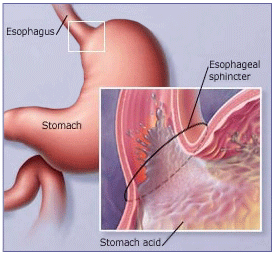 ysfunction in the sphincter at the bottom of the esophagus can cause food and stomach secretions to go backwards towards the esophagus and the mouth. Since the content of the stomach is acid, and the esophagus is not accustomed to such substances, it gets irritated, producing the pain that we call heartburn or pyrosis in medical term. On the other hand, this reflux of stomach content inside the esophagus is called GERD, or gastro-intestinal reflux disease. It results from a weakness in the lower sphincter of the esophagus which becomes unable to close and preventing stomach content from going backwards. In order to be complete, we should signal that another situation called hiatal hernia (protrusion (or herniation) of the upper part of the stomach into the thorax) can also cause reflux.
2-Now what can you possibly feel if you have reflux?
The cardinal symptom of reflux is the heartburn, which is the pain of the chest and mid-abdomen which follows the tract of the esophagus, this is why we call it a retro-sternal pain (for it is a pain felt behind the sternum or breast bone, the bone in the middle of our chest). However, this symptom is not necessary. Sometimes a constantly sore throat can be the only symptom felt. Some other people can have such an important reflux that they have a regurgitation of food into their mouth. Trouble or pain in swallowing can also be present in some other, as well as nausea. Moreover, people with GERD report excessive salivation because, as saliva is generally basic, thus it is the normal response of the organism to the acidic content of reflux.
KEEP IN MIND:
- All of us may feel heartburn some day in our lives, but this doesn’t mean we have reflux and need to treat our symptoms. In fact, in order to say that we have reflux, we need to experience heartburn at least twice a week.
- We can have reflux without having heartburn, but presenting any of the other possible symptoms of GERD.
3-Now, is all of this dangerous? Outside the pain we feel, is it so bad to have acid irritate our esophagus?
Well yes, untreated reflux becomes dangerous because it causes complications. In fact, the irritation of the esophagus damages it and can cause bleeding. This is what we call esophagitis. Moreover, esophagitis can cause narrowing of the esophagus, rendering swallowing difficult. At the extreme, this esophagitis can be a source for the development of esophageal cancer. Esophageal injury can also cause symptoms such as chronic cough, hoarseness and constant throat clearing, asthma, erosion of dental enema, dentine hypersensitivy and sinusitis. On the other hand, regurgitation can cause food to get into the breathing airways, especially during sleep. This can lead to infection of the breathing airways called aspiration pneumonia, which can become dangerous especially in elderly people.
4-What can I do to treat this reflux?
We can divide the treatment of reflux into 2 parts: the preventive and the medical treatment. We talk about preventive treatment because reflux does have precipitating factors which can precipitate and which, if taken into consideration, can help us reduce reflux. In fact, factors that can cause reflux include: obesity, pregnancy, smoking and some kinds of food and drinks. Of the food and drinks that can cause reflux we can list:
- Any caffeine containing product
- Coffee (even if decaffeinated)
- Carbonated drinks (soda, soft drinks…)
- Alcohol
- Tea
- Tomato and tomato based products
- Onion
- Chocolate
- Mint and peppermint
- Citrus fruits (oranges, grapefruit, mandarin…) or juice
- Fatty food
- Spicy food
Know that we know all this stuff about reflux, we can figure out techniques to prevent it and lessen its symptoms. Thus, restriction in eating reflux favoring food is helpful. The same goes with changing our eating habits in order to eat more frequent but less copious meals, as well as avoiding eating 2 hours before sleeping. Because smoking and obesity favor reflux, it is also useful to lose weight and stop smoking. Finally, it is also recommended to raise the head of the bed. Here, we should specify that it is not sufficient to only raise our head, for not only doesn’t it help reflux, but it also puts pressure on our neck. This is why we should raise our upper body for at least 15 to 20 cm (6 to 8 inches).
You may agree that doing all this is pretty constraining. Knowing that not all of these measures do bear the same importance, it would be useful if we gave you some more tips about lifestyle treatment of reflux. What is important to know is that all of these preventive behaviors are not mandatory to reduce reflux. In fact, all of them contribute more or less to lessening the symptoms. The more measure you adopt, the more you help yourself by reducing reflux and heartburn. However, studies have shown that it is much more important to adopt changes in eating habits than in the nature of the food we eat. Thus, losing weight, eating small but frequent meals, and restrain from eating 2 hours before sleep are more important than what you are eating in these meals.
TAKE HOME MESSAGE:
- Eat 4 or 5 five small meals a day, don’t overeat
- Restrain from lying within the first 2 hours after eating (if you want to take a nap, try to take it in a sitting position)
- Raise the head of your bed for at least 15 to 20 cm (you can use bed risers you put under the legs of the bead to raise the bedposts at the head of your bed or a therapeutic bed wedge pillow) P.S.: just using extra pillows does not help!
- Try as much as you can to avoid reflux favoring food, or at least to reduce their contribution in your daily food intake, especially before bedtime.
- Stop smoking
- Lose weight
Medical treatment of GERD involves two possibilities: either you work on reestablishing the mechanism which blocks stomach content from going backwards, or you simply eliminate the irritating acid secretion which is at the origin of the deleterious effects or reflux. The majors categories of medicaments include:
- Proton pump inhibitors or PPI (such as omeprazole/Prilosec, lansoprazole/Prevacid, rabeprazole/Pariet, esomeprazole/Nexium…): they stop the proton pump which is at the origin of the acid secretion in the stomach, and are the most effective and recommended reducers of gastric acid secretions.
- H2 Blockers (Pepcid, Tagamet, Zantac): they are effective in 50% of patients and provide short term relief from symptoms
- Prokinetics (Reglan, Urecholine): they strengthen the lower sphincter of the esophagus and make the stomach empty food to the small intestine faster. However, they have frequent and significant side effects and are thus not recommended
- Antacids (Malox, Ripoan, Diovol) use basic salts to neutralize the stomach acid. They are used before meals or when symptoms begin to reduce acidity. Long term usage of antacids can cause diarrhea, constipation, and problems in calcium regulation, so they are only recommended for short term usage
- Alginates foaming agents (Gaviscon) form a protective barrier in the stomach to reduce reflux and acidity. It acts faster than H2 blockers and PPI and on a longer term than antacids
5-Is there anything else I need to know?
Well yes, two more things to keep in mind: First, consult a doctor for two reasons:
- To know what medication you should take and in what dosage
- If symptoms persist or worsen despite medication
- You have trouble swallowing or pain when swallowing.
- You're vomiting blood.
- Your stools are bloody or black.
- You're short of breath.
- You're dizzy or lightheaded.
- You have pain going into your neck and shoulder.
- You break out in a sweat when you have pain in your chest.
- You have heartburn often (more than 3 times a week) for more than 2 weeks.
Author: Dany Matar
Refrences:
http://familydoctor.org
http://www.homebusinessandfamilylife.com
